How to Calculate Food Cost (Including Yield Loss): Formula, Template and a Worked Example
Food cost is ingredient cost divided by net sales. Most quick calculations understate it because they ignore trimming and cooking loss. Here is how to cost a plate with yield.
6 min read
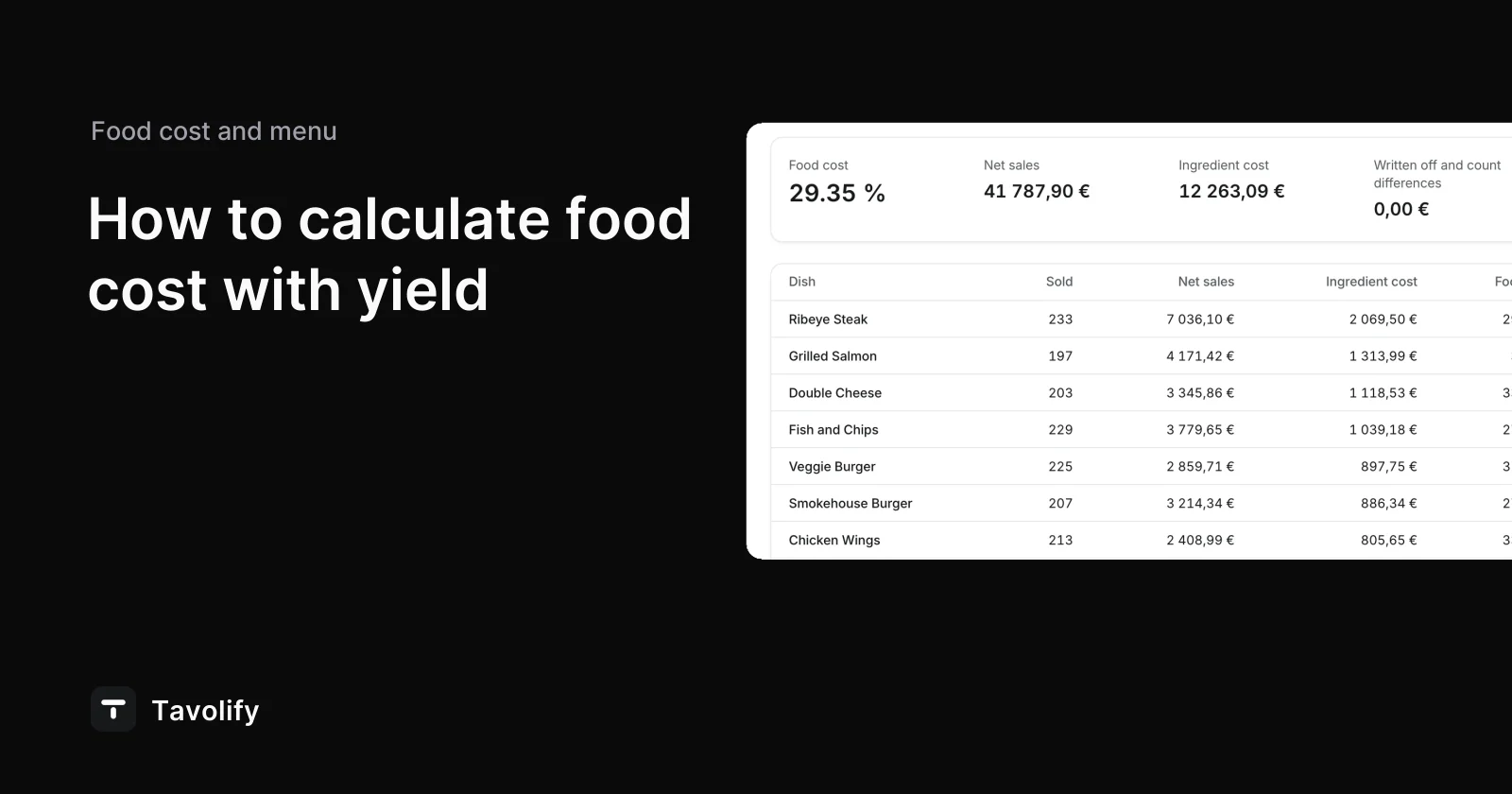
Food cost is the cost of the ingredients you used for the dishes you sold, divided by your net food sales, times 100. Calculate it twice: from your recipes (what it should cost) and from purchases and stock counts (what it did cost). The gap between the two is your loss. The most common mistake is ignoring trimming and cooking loss, which makes every plate look cheaper on paper than it is in the pan.
The food cost formulas
You need two, and Toast lays out both (post dated September 2026):
- Dish food cost = ingredient cost per portion ÷ net selling price × 100
- Monthly food cost = (opening stock + purchases − closing stock) ÷ net food sales × 100
Use net figures on both sides, with VAT removed. This guide uses Polish figures (PLN, net of VAT) because Tavolify is built for Polish venues. Confirm your VAT rate with your accountant or on podatki.gov.pl.
What counts as a good result? The National Restaurant Association's 2024 data, as quoted by Toast, puts the median food and non-alcoholic beverage cost of full-service US restaurants at 32.0% of sales. That is US data, so treat it as a reference point. A common rule of thumb is 30–35%. Your own target depends on the menu: a pizzeria can sit well below it, a place built on fish and meat will sit above.
Why a plate costs more in the pan than on paper
You buy gross: chicken with skin and bone, broccoli with stalks, pork with fat. Less reaches the plate, and cooking takes more. The share that survives from purchased weight to served weight is the yield.
The formula for the amount to buy:
amount to buy = amount on the plate ÷ yield
If the plate gets 180 g of chicken and yield is 75%, you buy 180 ÷ 0.75 = 240 g, and you cost 240 g, not 180 g.
You find yield yourself: weigh the product raw, weigh it after prep and cooking, divide the second number by the first. Do it three times per major product and average. Published tables are a starting point, but your supplier, your knife and your oven will give different numbers.
Worked example: a 40-seat bistro
The dish: chicken with rice, broccoli and cream sauce. Purchase prices and yields are illustrative, so use your own. The menu price is 36.00 PLN net.
| Ingredient | Net price per kg | On the plate | Yield | To buy | Cost |
|---|---|---|---|---|---|
| Chicken breast | 24.00 PLN | 180 g | 75% | 240 g | 5.76 PLN |
| Rice (dry) | 6.00 PLN | 80 g | 100% | 80 g | 0.48 PLN |
| Broccoli | 9.00 PLN | 120 g | 60% | 200 g | 1.80 PLN |
| Cream sauce | n/a | 1 portion | 100% | 1 portion | 1.10 PLN |
| Oil, salt, spices | n/a | 1 portion | 100% | 1 portion | 0.40 PLN |
| Total | 9.54 PLN |
Dish food cost: 9.54 ÷ 36.00 × 100 = 26.5%. Margin per plate: 36.00 − 9.54 = 26.46 PLN.
Skip yield and cost the ingredients exactly as they sit on the plate (4.32 + 0.48 + 1.08 + 1.10 + 0.40) and you get 7.38 PLN, or 20.5%. You understate the cost by 2.16 PLN per plate. At 1,500 plates a month that is 3,240 PLN missing from your result, and you will not know where it went.
Want 30% and a price? Divide cost by the target: 9.54 ÷ 0.30 = 31.80 PLN net. This dish is already below that price, so you can enlarge the portion or simply keep the margin.
Monthly food cost: theory against reality
The recipe result is your ideal cost. The purchases result is your actual cost. For the same bistro:
- Opening stock (count on day 1): 18,000 PLN
- Purchases in the month (net invoices): 41,000 PLN
- Closing stock (count on the last day): 16,500 PLN
- Cost of goods used: 18,000 + 41,000 − 16,500 = 42,500 PLN
- Net food sales: 140,000 PLN
- Actual food cost: 42,500 ÷ 140,000 = 30.4%
From recipes and portions sold, the ideal cost is 28%, or 39,200 PLN. The gap is 3,300 PLN. Toast lists the usual causes: waste, over-portioning, unrecorded usage, inaccurate recipes and supplier price changes. Check recipes and prices first, since they are cheapest to fix, then start weighing portions during the rush.
A template you can copy
Paste this into a spreadsheet, one row per ingredient:
| Dish | Ingredient | Net price per kg/l/unit | Amount on plate | Yield % | Amount to buy | Cost |
|---|---|---|---|---|---|---|
| =on plate ÷ yield | =amount × price |
Under the table add three cells: total cost, net price, and food cost (total ÷ price × 100). Refresh prices from invoices once a month. Re-weigh your three most expensive ingredients every quarter.
When a spreadsheet is enough, and when it is not
With a menu of 10–15 items and one person ordering stock, a spreadsheet is enough. You do not need software.
Trouble starts at 60 items, supplier prices that move weekly, and stock counted from memory. Then every price change means recalculating dozens of rows by hand.
In Tavolify, recipes and stock live in Stock: you attach ingredients to dishes and the system shows real food cost and differences after a stock count. Inventory with recipes is in the Multi plan (349.00 PLN per month, as of November 2026); it is not in Start or Pro. Sales, cash shifts and hours worked are in Reports, on your phone too. Current prices are on the pricing page. If you want to see it on your own menu, the 30-day free trial needs no card.
FAQ
What is a good food cost percentage for a restaurant?
Most operators aim for 30–35% of net sales. The 2024 median for full-service US restaurants was 32.0% (National Restaurant Association data, quoted by Toast). Your target depends on the concept: expensive meat and fish push it up, pizza and pasta pull it down.
Should I calculate food cost on gross or net prices?
Net, on both sides. Take purchase costs from invoices without VAT, and remove VAT from the menu price. Using gross figures understates food cost by the amount of the tax.
What is yield in recipe costing?
Yield is the weight after prep and cooking divided by the weight you bought. If 1 kg of broccoli leaves 600 g after trimming, yield is 60%. It tells you how much raw product to buy for each portion.
How often should I calculate food cost?
Recalculate dish costs whenever supplier prices or the menu change. Calculate actual food cost monthly, or weekly if losses are high, with a stock count at the start and end of the period.
Does food cost include labour and packaging?
Classic food cost covers ingredients only. You can add takeaway packaging to the dish cost if takeaway is a big share of sales. Labour is tracked separately as labour cost.
Also in PolskiTürkçeУкраїнська